
How Search and Discovery Changed in 2025 — According to Knotch Labs
2025 was the year the content marketing playbook started rewriting itself.
AI changed how audiences discover information. Search behaviors transformed. Journeys got more chaotic. And engagement patterns that once felt predictable suddenly became anything but. But instead of guessing at what changed (and what will continue to change), we looked at how people actually behaved.
Using anonymized, aggregated analysis across thousands of content experiences in the Knotch ecosystem, we identified three fundamental shifts that defined 2025. These aren't predictions or opinions. They're patterns visible in the data — the way people really interacted with content this year.
The result is a clearer picture of what's coming in 2026, and what smart content teams will do about it.
1: Audience journeys became definitively nonlinear
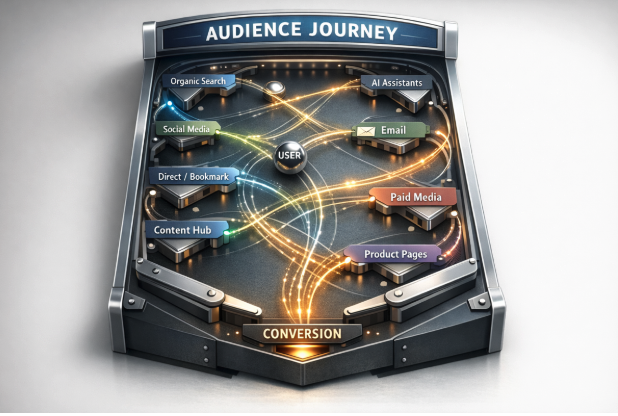
The audience journey funnel had been warping for years, thanks to new digital channels. In 2025, it broke. Journey analysis across the Knotch ecosystem showed visitor paths that looked less like a funnel and more like a pinball machine.
We observed visitors re-entering journeys through social, AI assistants, email, or direct traffic; multi-session paths becoming the norm (something Knotch uniquely measures by tracking individual users across sessions); conversions often coming from visitors whose first touch was nowhere near the "top." We also saw a meaningful rise in "looping behavior" — visitors bouncing between top- and mid-funnel content prior to conversion.
The classic linear funnel couldn't survive in a reality where both buyers and algorithms decide the path forward. This pattern intensified even further when AI entered the picture. Visitors arriving from LLM platforms take 2x the number of unique pathways to conversion compared to other traffic sources. Their journeys were shorter in duration but more concentrated — three days over an average of 1.9 sessions, versus nine days over three sessions for non-LLM visitors.
What became clear in 2025 is that the concept of "guiding" customers through a predetermined path is obsolete. Brands that succeeded were those with teams that built content ecosystems responsive enough to support any entry point, flexible enough to accommodate looping behavior, and instrumented well enough to recognize patterns as they emerged.
What smart teams should do in 2026:
Stop planning journeys. Start analyzing actual visitor pathways. The teams winning now are those who respond to behavior, not those who try to script it.
2: LLM visitors emerged as one of the highest-intent segments on the internet
A lot has been written about AI assistants reshaping search, but the data tells a more nuanced story. While direct LLM-driven traffic to websites remained small in volume throughout 2025, it consistently showed outsized engagement and conversion behavior.
Across the Knotch sample analyzed, LLM visitors spent roughly 2x longer on content than the typical site visitor and scrolled 1.3x deeper into pages. But the conversion story was even more striking. One study we included in our review showed that although LLM traffic represented roughly 0.06% of visits, it accounted for 0.20% of conversions — more than 2x its size.
But that's only what traditional analytics can see. In pilot surveys conducted across several Knotch client sites this year, 35% of visitors reported using AI tools — such as Google AI Overviews, ChatGPT, or Gemini — to research the topic or brand before arriving at the website. That means that the direct LLM referrals tracked in analytics are just the tip of the iceberg. The real AI influence – what we call “AI Trojan Horse traffic” – is happening invisibly, shaping intent and priming decisions long before a click ever reaches your site.
And these aren’t casual browsers; they are highly interested, high-intent audiences. LLM-referred visitors took 1.6x more actions per visit — downloads, subscriptions, tool usage, purchases. They arrived with defined intent and acted decisively.
By year's end, it became clear that LLM traffic represents something different from traditional discovery channels. These aren't awareness-stage visitors stumbling onto your content. They're mid-funnel prospects who've already done their homework, often with AI assistance, and they’re ready to evaluate specific solutions.
What smart teams should do in 2026:
Start tracking LLM referrals as seriously as you track SEO. Even small numbers can be meaningful.
3: Organic search still drives the most visitors — but it no longer defines discovery
Google remains a primary driver of content discovery, especially for evergreen topics. But in 2025, organic search felt the impact of AI-powered, zero-click answers.
While our research saw organic search still producing the largest volume of traffic, AI-driven search experiences are siphoning off more top-of-funnel queries, and a growing number of "side-door" visits are coming through AI summaries, snippets, and assistant-generated recommendations.
So, has organic search lost its value? Not at all; what the data revealed is more subtle than "AI is killing SEO." Organic search continues to perform well — particularly for mid-funnel, intent-driven queries. From March through August, SEO accounted for roughly 11% of total traffic but generated nearly 15% of all conversions, a Knotch Conversion Index of 111 (11% higher than the site average).
But traditional search’s monopoly is over. Discovery is now distributed across multiple AI-influenced touchpoints, each playing a distinct role in how audiences find and evaluate content.
What smart teams should do in 2026:
Optimize for both SEO visibility and AI assistant friendliness — structured answers, clarity, and intent alignment matter more than ever.
2025 changed everything — but the winners weren't the busiest teams. They were the clearest.
Looking across the data, the most successful content teams in 2025 shared a few traits:
- They tracked the right signals. Conversion Index over vanity metrics. Journey patterns over assumed funnels. LLM referrals alongside traditional analytics.
- They optimized their ecosystems, not just their pages. They understood that content works as a system, with discovery happening across multiple channels and conversions emerging from nonlinear paths.
- They invested in content that people actually value. LLM visitors arrived with intent because they'd already been served relevant, high-quality content during their research. The brands they chose were the ones that delivered clarity and substance.
- They looked at their journeys instead of assuming them. The teams that succeeded studied actual audience behavior — the looping, the side-door entries, the nonlinear paths — and built for reality rather than theory.
- Humans stayed in the driver’s seat. AI showed them new patterns in discovery and intent, but they decided what those patterns meant and how to respond.
The biggest truth from the data is simple: The market rewarded clarity, focus, and real value in 2025. It will reward them even more in 2026.
If you want to understand how your content compares — or get a deeper cut of any of the data included here — we're happy to run a personalized diagnostic.
Published December 27, 2025
Become a thought leader
Become a thought leader





Trusted by the largest (and now smartest) brands in the world.
“Before Knotch we did not understand what content was driving business results. Now we understand which content moves the needle. Knotch’s cohesive reporting and insights paint a real picture of what’s happening on our website instead of the patchwork quilt that comes from a Google Analytics approach. With Knotch we have been able to re-prioritize ad spend, route better leads to our SDR team, and inform our content development initiatives.”

"The Knotch platform ensures that we deliver high-performing content tailored to young home shoppers, enhancing their experience and driving better business outcomes.”

"Our partnership with Knotch has been highly successful, empowering us to leverage data-driven insights and refine our content strategy.”
