
Social starts promising journeys — but then they disappear

Social is a crucial full-funnel channel for verticals like CPG and entertainment. But enterprise verticals like finance and B2B largely consider it to be an awareness play — good for reach, weak on outcomes.
Half of that framing is right. The half that's wrong is more interesting.
Knotch analyzed 14 enterprise content programs throughout 2025 — spanning financial services, healthcare, B2B technology, real estate, and education, and representing more than 750 million page views. We found something surprising: Organic social is disproportionately likely to bring you visitors who are encountering your site for the first time. Among organic social visitors who appeared in a multi-touch path to conversion in our study, 45% of them were encountering a brand's content for the first time. That’s the highest first-touch share of any external traffic source other than paid search, and it makes social one of the most efficient cold-audience entry points measured.
But here’s the problem: The path almost always ends there. Organic social visitors recirculate (i.e., visit another page on the same site) at 4% and paid social visitors at 2.2% — both well below the cross-channel average of 5.6%. Knotch’s research has found that recirculation rate is the top predictor that a site visitor will ultimately become a customer.
Social, in other words, is great at driving first-time traffic but then proves to be terrible at driving recirculation. Visitors are disproportionately likely to end their journeys after that initial click.
Social opens the door — it just doesn't invite anyone in.
The conversion rate is fine, but the audience is missing
Here’s something else that might surprise you: Despite organic social visitors’ low likelihood of recirculation, social’s conversion rate is meaningful. At 2.16%, it sits above organic search, email, and direct traffic — three channels that content programs count on for revenue.
But that number requires context. Organic social accounts for 0.4% of total content views across these 14 programs — a sliver of the traffic mix. And of the visitors who do arrive, almost none make it to a second page. The overall conversion rate is being carried by a small share of visitors who continue beyond that first page.
The gap worth staring at is between what organic social visitors do when they arrive — engage at 28% scroll depth, which is mid-pack across all channels — and what the program lets them do next.
Paid social buys the disengaged
When it comes to enterprise brand content, if organic social's weakness is volume, paid social's weakness is structural. Paid social drives meaningful traffic — 5% of total content views — but then converts at 0.97%, the lowest rate of any channel measured. Paid social visitors scroll to 19% of content on average, the second-lowest across all channels. They recirculate at 2%, also near the bottom.
The cleanest contrast in the dataset is between paid social and paid search. Both deliver 5% of content traffic. But paid search converts at 7.12%, while paid social converts at 0.97%. The paid spend is comparable; the audience it produces is not.
Paid social does what it's built to do: buy attention from people who weren't looking for the brand. The question is what happens after the click. Visitors arrive cold, scroll half as deep as paid search visitors, leave without recirculating, and don't convert. Programs evaluating paid social by traffic volume are measuring the part of the funnel where paid social is strongest and ignoring the part where it falls apart.
Here’s a clue as to why it fails: Most landing experiences for paid social in this dataset are brand-led articles designed for someone who’s already in-market. That is a mismatch between content and audience, and the conversion rate shows it.
The recirculation gap is the actual story
When it comes to recirculation, the gap between social and the channels that rank above it is wide and consistent. Organic search recirculates at 8.6%. Email at 6.7%. Direct traffic at 5%. Organic social at 4% sits near the floor of external acquisition channels. Paid social at 2.2% sits below it.
Earlier research on recirculation as a conversion predictor found that the steepest conversion gains happen when programs move recirculation from the 10–15% range into 15–20%. The pattern is a staircase rather than a smooth curve. Most social-referred traffic isn't approaching that threshold.
The distinctive feature of the social gap is that organic social visitors do engage on arrival. Scroll depth is 28%, mid-pack across the channel set, just one slot behind paid search at 29%. They're reading, but they don't have anywhere to go next. Just as with paid social, the problem is that they aren’t getting hooked — but while paid social visitors seem to be getting dropped off in the wrong places, organic social visitors are arriving on content that initially attracts them but then fails to keep their interest.
The first-touch advantage no program is built to use
The 45% first-touch share for organic social is a structural advantage. First-touch is where converting multi-touch paths begin, and a majority of conversions can be attributed to mid-touch visits — the visits between first contact and the converting action. Programs depend on first-touch visitors coming back. Organic social delivers a higher share of first-touch visitors than any external channel except paid search, then loses almost all of them.
The actionable gap is between organic social's first-touch share (45%) and its recirculation rate (4%).
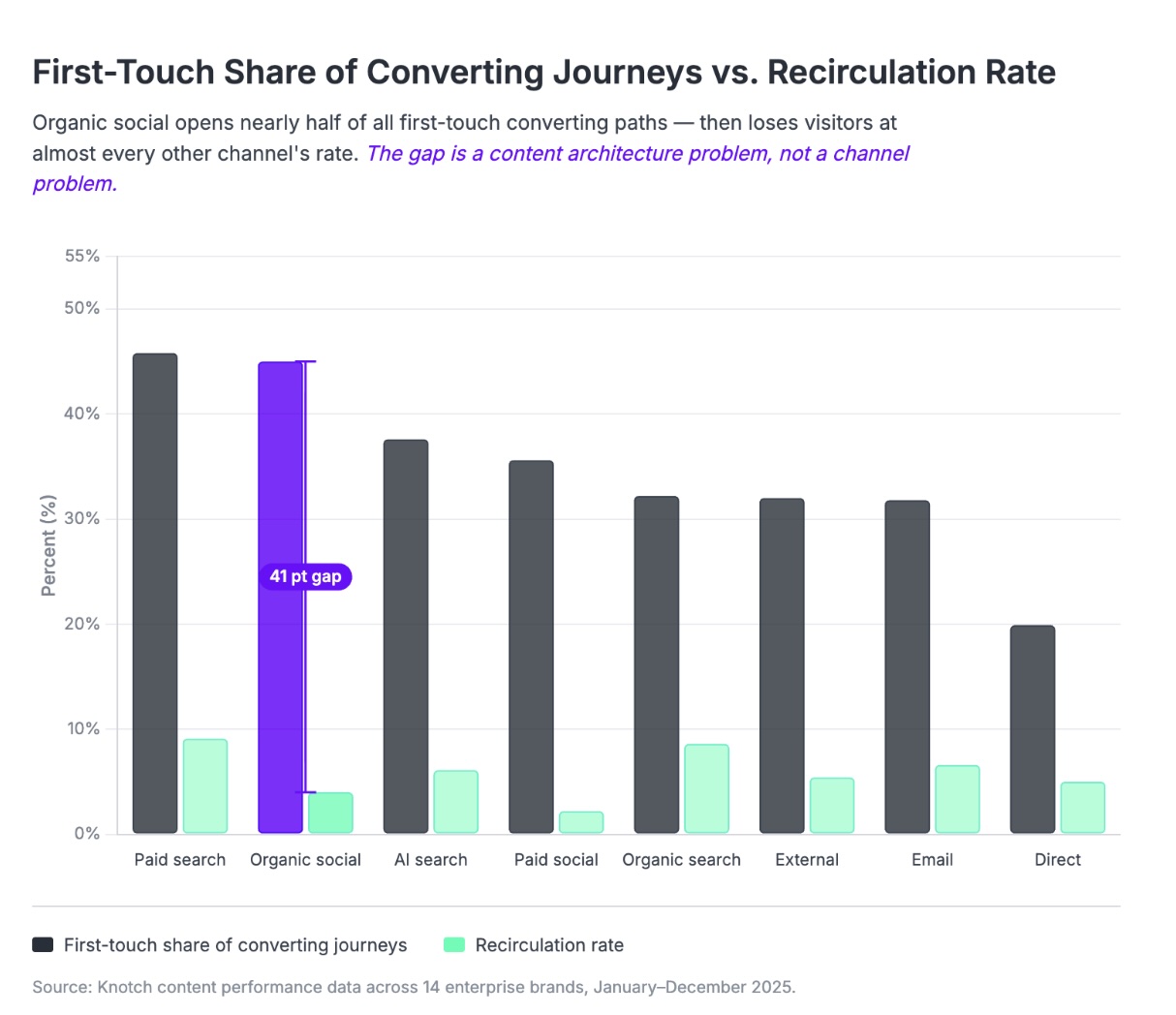
This is a specific architectural failure with a specific fix: The content experience for someone arriving from a social feed has to be built to earn one more page view.
We can find some hints for how to do this in two programs in Knotch’s dataset that did see organic social converting well above the channel average. Their content shares a pattern:
- A clear, low-friction continuation path designed for someone who arrived cold.
- A related read with context about why it's the next read.
- A contextual prompt rather than a generic CTA.
- A short sequence built for someone who knows nothing yet — and might want to know one more thing.
That pattern doesn't match a generic "related articles" widget. It’s designed to spur recirculation on behalf of cold-start visitors, hinting at what they should encounter next and why they should encounter it next. Most content programs treat that as a UX detail. But in a dataset where organic social delivers the highest external first-touch share and the second-lowest recirculation rate, the UX detail is the entire problem.
The metric that should replace traffic from social
Social's role in content strategy has been misdiagnosed in two directions. One, organic social is more capable of producing converting paths than its volume suggests. Two, paid social is producing less engaged audiences than its traffic numbers reveal. Both findings point to the same conclusion: Programs are evaluating social on the wrong axis.
The right axis is recirculation. A channel that opens 45% of first-touch paths and converts at 2.16% when visitors do engage has real upside. But this only plays out when the content experience is built to capture the second page view.
Recirculation is the metric to follow. Whether social-referred visitors make it to a second page tells you what the channel is doing for the program — and whether the content is doing its job.
Published on May 19, 2026
Become a thought leader
Become a thought leader







Trusted by the largest (and now smartest) brands in the world.
“Before Knotch we did not understand what content was driving business results. Now we understand which content moves the needle. Knotch’s cohesive reporting and insights paint a real picture of what’s happening on our website instead of the patchwork quilt that comes from a Google Analytics approach. With Knotch we have been able to re-prioritize ad spend, route better leads to our SDR team, and inform our content development initiatives.”

"The Knotch platform ensures that we deliver high-performing content tailored to young home shoppers, enhancing their experience and driving better business outcomes.”

"Our partnership with Knotch has been highly successful, empowering us to leverage data-driven insights and refine our content strategy.”
